




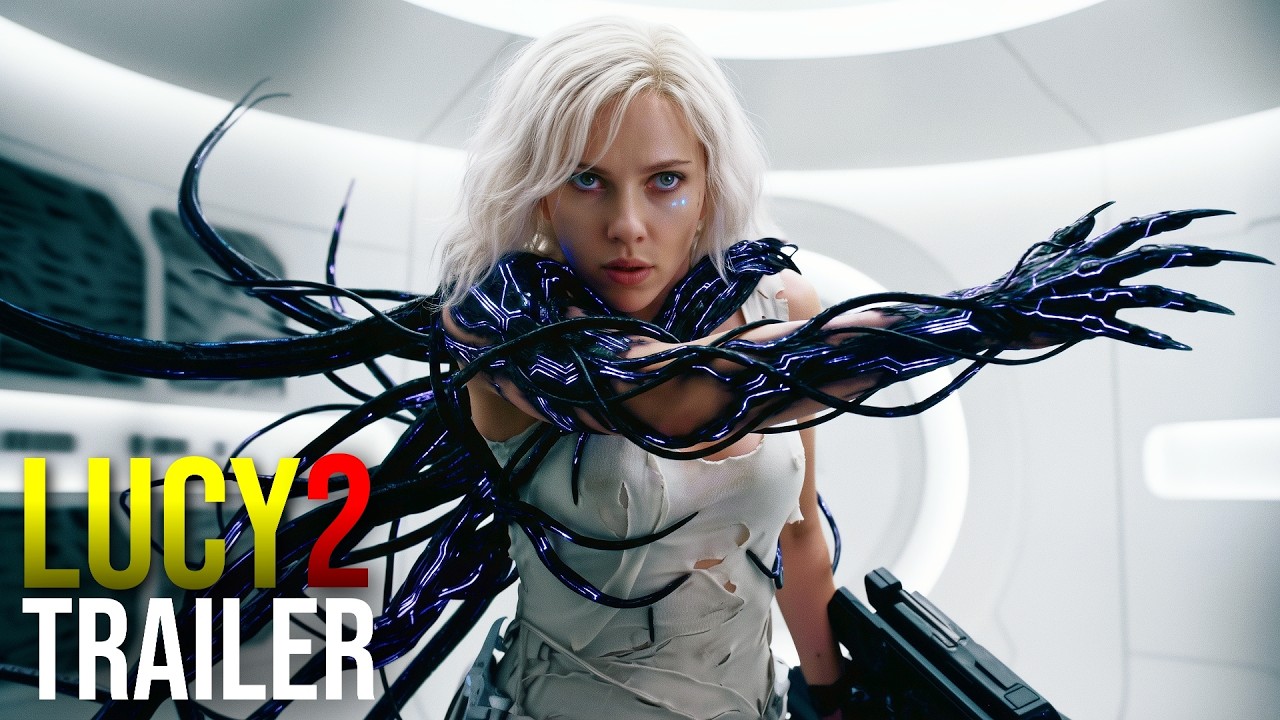
A Return to a Dangerous Idea
More than a decade after Lucy ended on a note that felt both triumphant and unsettling, the concept trailer for Lucy 2: Reawakening invites us back into a world where intelligence itself is the ultimate weapon. The original film concluded with a provocation: what happens when a human mind reaches 100% of its capacity? The trailer suggests that the more interesting question may be what remains after such transcendence has already occurred.

Presented as a concept trailer rather than a finished studio release, Lucy 2: Reawakening positions itself as an intellectual echo of Luc Besson’s 2014 film. Scarlett Johansson appears once again as Lucy, while Morgan Freeman returns as the calm, professorial voice grounding the story in speculative science. Whether this sequel becomes a full production or remains an idea, the trailer alone is rich enough to merit serious discussion.

Reinterpreting the Ending of the Original Film
The most intriguing aspect of the trailer is how it reframes the ending of Lucy. In that film, Lucy’s physical form dissolved as her consciousness expanded beyond time and matter, leaving behind a simple message: I am everywhere. The new footage hints that this was not an ending, but an incomplete transformation.

What Was Left Behind?
According to the trailer’s visual language, Lucy did not vanish so much as she fragmented. Data streams, biological residue, and unexplained phenomena suggest that something tangible remained on Earth. This reframing subtly shifts the tone of the story. Transcendence is no longer purely liberating; it is also irresponsible.
- The power Lucy unlocked may be reproducible.
- Humanity may be tempted to control what it does not understand.
- Knowledge itself becomes a contaminant.
This is a darker interpretation than the original film offered, and a more mature one.
Scarlett Johansson and Morgan Freeman: Familiar Anchors
Johansson’s presence in the trailer is more spectral than physical. She appears less as a character and more as an idea, a reminder of what humanity has already unleashed. It is a smart choice. Lucy, at this stage, should not behave like a conventional protagonist.
Morgan Freeman’s return as Professor Norman functions as the moral and intellectual counterweight. His measured delivery once again provides the audience with a scientific framework, even as the concepts stretch beyond credible neuroscience. Freeman’s role seems to be evolving from expositor to reluctant guardian, a man who understands the danger of asking the wrong questions.
Evolution or Warning?
The trailer’s central tension lies in its ambiguity. Is Lucy’s legacy the next step in human evolution, or a cautionary tale about curiosity without restraint? The imagery leans heavily toward the latter. Stark visuals, ominous silences, and fractured timelines suggest a world destabilized by knowledge arriving too soon.
Thematic Undercurrents
Like the first film, Lucy 2: Reawakening appears less interested in realism than in philosophy. It uses science as metaphor, asking questions that have little to do with actual brain capacity and everything to do with power.
- Can humanity be trusted with unlimited intelligence?
- Does evolution require sacrifice?
- Is transcendence an escape, or an abdication of responsibility?
These are questions that linger long after the trailer ends.
Visual Style and Tone
Stylistically, the trailer favors restraint over spectacle. Instead of relentless action, it offers controlled imagery: glowing data, silent laboratories, and human faces reacting to forces they cannot name. This approach aligns with the film’s philosophical ambitions and distinguishes it from more conventional science fiction sequels.
If the original Lucy was a cinematic thought experiment wrapped in action-movie clothing, Lucy 2: Reawakening looks poised to strip away even that comfort.
Final Thoughts
As a concept trailer, Lucy 2: Reawakening succeeds not by promising answers, but by reopening questions we assumed were settled. It challenges the optimistic reading of the first film’s ending and replaces it with something more uneasy and, ultimately, more honest.
Whether this project becomes a full sequel or remains a speculative exercise, the idea at its core is compelling. Intelligence without limits may not be humanity’s greatest achievement, but its most dangerous temptation. If Lucy 2 ever fully materializes, it has the potential to transform a divisive cult film into a thoughtful science fiction meditation on what we choose to know, and what we should leave alone.